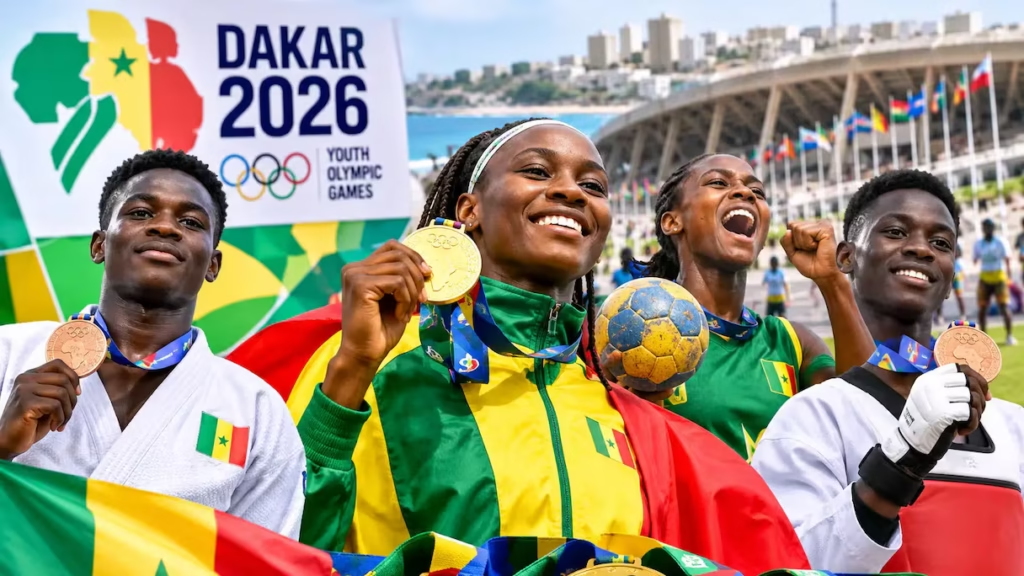
As the fourth edition of the Youth Olympic Games draws to a close, the International Olympic Committee (IOC) and the Local Organising Committee (Cojoj) have released a provisional assessment. Awarded to Senegal in 2018, this edition is the first to take place on African soil. For ACNOA, it invites us to look beyond the results and ask what it leaves behind for the continent.
A first assessment welcomed at the highest level
IOC President Kirsty Coventry offered her congratulations to the Cojoj, to its president Mamadou Diagna Ndiaye, and to the Senegalese state and people. She recalled that it took eight years to bring these Games to fruition, between the pandemic and several postponements. What struck her most, she said, was how alive the venues were: the volunteers, the teams and the schoolchildren who came out in large numbers to cheer on the athletes. The people she spoke with told her the Games had far exceeded their expectations and strengthened their confidence in Africa’s capabilities.
A measurable effect on the country’s image
The Cojoj points to concrete signs of this reach. Its coordinator, Ibrahima Wade, cites a preliminary analysis showing that Senegal’s capacity for influence had been multiplied by 2.17 by the end of the first week, on 9 November. He sees this as evidence that Olympic sport can serve as a lever for promotion. Dakar’s tourism professionals, meanwhile, are reportedly already seeing a high number of bookings for the year-end holidays.
A host country rising to the occasion, on and off the field
Beyond organisation, Dakar 2026 drew on infrastructure, event coordination, security, transport and the welcome of delegations across several venues in Dakar and Saly. The Iba Mar Diop complex, which hosted the athletics events, became one of its symbols. Senegalese athletes also shone: five gold medals, three in wrestling, one in 3×3 basketball and one in taekwondo, along with four bronze medals. This performance reflects the progress of Senegalese youth sport and shows that training and coaching bear fruit on the international stage. The country ranks third on the continent in the medal table.
Visitors, officials and volunteers were welcomed in an atmosphere of conviviality and fervour. This hospitality strengthened Senegal’s image as a host for major sporting events and showcased its culture to the thousands of visitors present.
A legacy to pass on
For ACNOA, the significance of Dakar 2026 goes beyond the medal table. It shows what the continent can achieve when it invests in organisation, training and trust in its young people. As the celebration ends, the challenge now is to sustain this momentum, so that the young athletes and teams trained in Dakar carry it back to their countries.